
Lee Lee
Curatorial statement
Mizel Museum exhibition, Denver
May we have a moment of silence for all those who have been silenced?
…
Resilience is the strong common thread I have witnessed in the over 40 countries I’ve spent time in around the world.
I tend to visit developing countries where people have struggles that we in this country can’t fathom, genocide among the hardest to consider. Unless we have been through it directly, we can not understand it. But that does not mean that we can’t have compassion.
When the opportunity arose to speak about genocide through the Mizel Museum, I asked myself how such a severe topic can be presented in a way that encourages consideration which would lead to this compassion. I’ve been studying how war is conveyed through media and creative works for 15 years. It’s aggressive, shocking, ugly and all too easy to turn away from. Who wants to look at a pile of dead bodies? Genocide is of course all these things, but in a culture inundated with sensationalized media & information, I thought it best to present it on a human scale, building personal connections to those directly affected.
My purpose is to engage.
Many of these works address aspects of genocide that are often overlooked. They are the quieter aspects that deal with the long term effects of genocide. The strengths that are necessary to survive the initial violence, mourn losses while displaced, and even come to points of reconciliation are all to be applauded – our community could learn a great deal from the stories portrayed through the art displayed here.
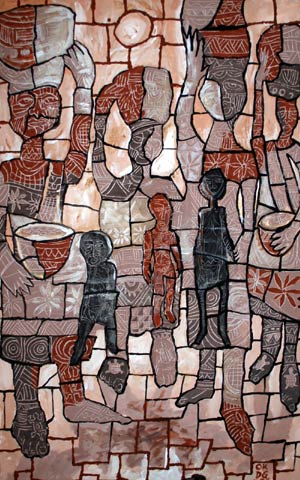
Moyo Okediji has created ceramic reliefs that convey displacement through fragmented figures made literally from earth. He shared an interesting fact that the only art form surviving the genocide in Darfur now is ceramic based, so the material is unexpectedly appropriate. When in Africa I found such a strong energy that emanates from the land itself, and manifests through the spirited people there. Despite the displacement experienced across the continent at one time or another, Moyo’s solid figures embody the strength and energy I had witnessed there.
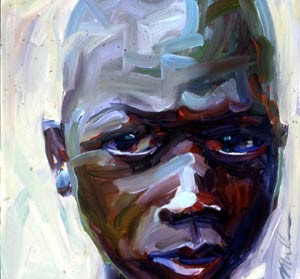
Though I feel all the work is beautiful, not all of it is pleasant. In my mind, one of the most striking works is Michelle Torrez’s Enchanted Eyes. This is a portrait of a young Sudanese boy who had both his hands hacked off with a machete. Michelle does not dwell on the gore aspect of hacked hands; instead she paints just his face. She has captured the frustration and hurt so vividly through his gaze. She said to me once, “the eyes tell the whole story”, indeed these do. That look – that energy – it’s unspeakable, yet manifested so powerfully through her brush.
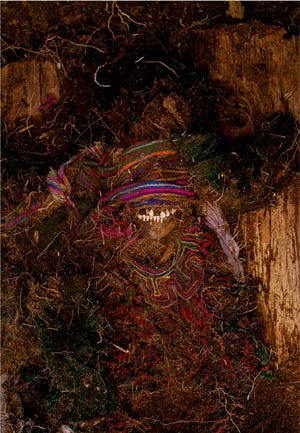
Haunting too is Jonathan Moller’s photographs from Guatemala. I am especially moved by his large exhumation piece, with skeletal teeth gleaming. Still, the brightly colored Mayan textiles sing out as a manifestation of the creative human spirit even as they melt organically into the surrounding grave.
This work speaks of the passage of Time, which was a huge consideration both in building this show and in my own paintings. When I visited the landmine clearance work being done near the former DMZ in Vietnam by Clear Path International, I met a farmer who had just lost both his hands to an explosion of a tiny bomb he mistook for a dirt clod in his field. The depth of sorrow in his wife’s eyes was enough to drown in.
It’s amazing how long the effects of genocide continue. Cambodia experienced one of the greatest acts of genocide in the 20th century, and today remains saturated with unexploded ordinance. In my mind, anyone who lays down bombs needs to consider the implications for their grand children’s children – for they will continue to feel the repercussions for that long.
While I was disturbed by the physical evidence of destruction in Southeast Asia, I was also amazed at the resilience of people there who steadily work to rebuild their lives. In my Ta Prohm paintings, I highlighted the tree roots that cascade down the temple faces to reflect growth despite a history stained with blood.
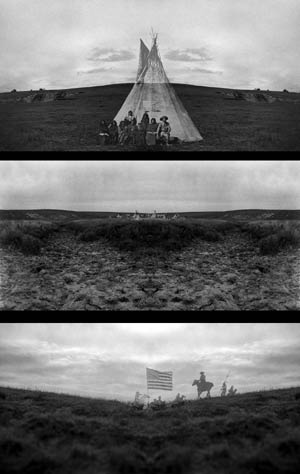
I thought it vital to include not only contemporary effects genocides, but how we as Coloradoans are directly tied. Ghosts from our past arise through Thomas Carr’s digital collages based on Native American battlegrounds in this area.
More current are the haunting sound installations by Sasha Gorelik and Evan Brown which are based on recordings from the bowels of an intercontinental ballistic missile silo buried in our own land. They layered these sounds with various samples taken from around the world. African drums, ancient Cambodian flutes interspersed with institutionalized accounts of various genocides make the work relevant in all areas. A phenomenal work that heightens the effects of the three themes explored here; severity, mourning/loss and strength/resilience.
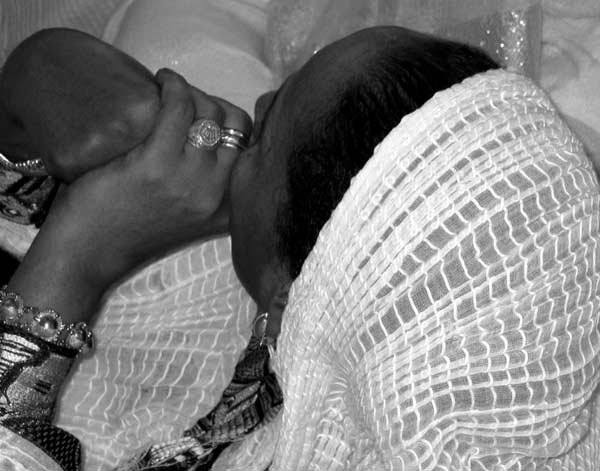
More positive are Izabela Lundberg’s photographic portraits of survivors who dwell here in our own community. She has very sensitively touched on their pasts while emphasizing the strengths that were necessary to get to where they are today. These people add such richness to the fabric of our community, and I’m inspired when I see them embraced. A truly inspirational woman, I would like to invite her now to speak of her work and our community.
Presented January 11, 2007 at the Mizel Museum
 VOICES